Categories
PTE

Tongue Twisters

Here’s a list of tongue twisters you can try to improve your pronunciation and fluency. Have fun!!


1.

Peter Piper picked a peck of pickled peppers

A peck of pickled peppers Peter Piper picked

If Peter Piper picked a peck of pickled peppers

Where’s the peck of pickled peppers Peter Piper picked?

2.

Betty Botter bought some butter

But she said the butter’s bitter

If I put it in my batter, it will make my batter bitter

But a bit of better butter will make my batter better

So T’was better Betty Botter bought a bit of better butter

3.

How much wood would a woodchuck chuck if a woodchuck could chuck wood?

He would chuck, he would, as much as he could, and chuck as much wood,

as a woodchuck would if a woodchuck could chuck wood.

4.

All I want is a proper cup of coffee,

Made in a proper copper coffee pot

I may be off my dot

But I want a cup of coffee

From a proper coffee pot.

5.

Round the rough and rugged rock, the ragged rascal rudely ran.

6.

The sixth sick sheik’s sixth sheep’s sick.

7.

She sells seashells on the seashore.

The shells she sells are seashells, I’m sure.

And if she sells seashells on the seashore,

Then I’m sure she sells seashore shells.

8.

How much ground would a groundhog hog, if a groundhog could hog ground? A groundhog would hog all the ground he could hog, if a groundhog could hog ground.

9.

If one doctor doctors another doctor,

Then which doctor is doctoring the doctored doctor?

Does the doctor who doctors the doctor, doctor the doctor the way the doctor he is doctoring doctors?

Or does he doctor the doctor the way the doctor who doctors doctors?

10.

I thought a thought,

But the thought I thought wasn’t the thought I thought I thought.

If the thought I thought I thought had been the thought I thought,

I wouldn’t have thought so much.


How did it go? Difficult, is it?

It’s okay… keep practicing. You are improving your fluency and pronunciation with these tongue twisters.

Share this and challenge your friends.

Categories
Uncategorized

NEPALI NAATI VOCABULARY AUGUST 2020

Just like last month, we are back with fresh new Nepali NAATI vocabulary that was repeated in July.

For August, we selected these two topics because they were repeated often throughout the month.

The first topic is- A GP Visit by an Elderly Woman for Cholesterol Checkup

And…

The second topic is- Lodging a Complaint about Buying an Expensive Computer

So, let’s dive right into the most repeated words from these two topics.

Topic 1- A GP Visit by an Elderly Woman for Cholesterol Checkup

Cholesterol रगतको नशामा बोसो जम्नु
Hypertensionउच्च रक्त-चाप
Prescriptionऔषधि पर्ची
Consultationपरामर्श
Databaseआंकडा / तथ्यांक / प्रणाली
Similar Medicineउस्तै खालको औषधि
Tabletचक्की
Bookस्थान सुरक्षित गर्नु / ठाउँ पक्का गर्नु
Appointmentभेटवार्ता
Resultनतीजा
Blood Testरक्त परीक्षण

Topic 2- Lodging a Complaint about Buying an Expensive Computer

Customer Serviceग्राहक सेवा अधिकृत
Lodgeदायर गर्नु
Complaintउजुरी / गुनासो
Noteटिप्पणी / टिपोट
Reasonable Priceउचित मूल्य
Salespersonबिक्रि प्रतिनिधि
Installmentकिस्ता
Paperworkकागजी काम
Depositजम्मा गर्नु / धितो
Consumer Protection Lawउपभोक्ता संरक्षण कानुन
Registerदर्ता गर्नु
Investgateअनुसन्धान गर्नु

So, these are the most repeated topics in the NAATI CCL exams in August. Use these to brush-up on your Nepali vocabulary. You can follow the links to read past repeated topics for the month of June and July

For more details on joining our CCL NAATI classes contact us on 0422 279 722. We’ll be back with a new set of vocabulary next month.

Categories
PTE Tips

PTE Listening Fill in the Blanks

Today we will deal with the PTE Listening Fill in the Blanks question type. We will start by understanding the task details and then, we will talk about how to solve this task.

Let’s begin.

About the Task

In the PTE Listening Fill in the Blanks task, you will see a passage with missing words. Your job is to listen to the audio prompt and then fill the blanks with correct words.

You will have 7 seconds to prepare before the audio begins playing. This means you should use the initial 7 seconds to read the passage and get an overview of what the passage is about. If you can’t finish reading the passage, it’s okay; we just want you to get started with an idea of what the passage is about.

This task assesses your listening and writing skill. And since there is no negative marking in this question type, you can give it your best shot by judging which word might come next after reading the passage and understanding its context.

You should remember that the recording plays once only. So, if you miss a part of the audio, you won’t be able to rewind it and listen to it again. Thus, you must remain concentrated the whole time.

With that in mind, let’s dive into how to handle PTE Listening Fill in the Blanks question type.

How to Solve It

Some students find it easier to type the answer directly into the computer. While this is a good way to answer the question, we recommend that students make use of the erasable note board and write the answers first on the board and later transfer it to the computer.

Since the section will only progress further after you have clicked the next button, you will have ample time to transfer your answers from the board to the computer.

As you are listening to the answer, keep focused on what the speaker says. This way, when the speaker gets to the missing word, you can be prepared to note it down in your erasable note board or directly on the computer.

If you think the speaker is speaking fast and that you might miss the next word, just write short forms of abbreviations so that you can recognise the word later which you can use to type the final answer on the computer.

After the audio is finished and you are done transcribing the answer in the computer, read the passage again to make sure the answers make sense in their context in the passage. Also, correct any spelling errors that you may have made.

This is an easy task and the majority of students will have no difficulty because the speaker dictates the answers. All you need to do is listen actively enough to identify the correct answer when the speaker speaks.

However, don’t be too confident just because we say it is an easy task, you still need to make sure that you practice enough to get into a habit of listening and writing the correct words with correct spelling.

Again, we reiterate that you should not leave a blank space. There is no negative marking, so, even if you miss the word, give it your best guess and write something that you feel fits the sentence. It’s better to have something rather than nothing.

And in the end, keep practicing. If you need any guidance with PTE, contact us today and get closer to getting the score you want in PTE.

Good luck with your exam.

Categories
PTE Tips

PTE Listening: Multiple Choice Multiple Answers

The most common issue that we have seen our students struggle with, in the PTE Listening Multiple Choice Multiple Answers task is that they are confused between whether to take notes or listen to the audio or read the question and options.

Today, we’re going to show you exactly how to solve this question. But before that, let’s get familiar with the task.

About the Task

In the PTE Listening Multiple Choice Multiple Answers task, you will hear an audio prompt of between 40-90 seconds. And after listening to that recording, you should select the correct answers from a list of options. Once the audio has played, you can’t listen to it again. That’s why… it’s important to remain focused and listen to the audio.

The Most Crucial Time

You will have 7 seconds to prepare before the audio begins playing. And this is the most crucial time that students usually waste.

Remember, you have 7 seconds to get ready for the prompt. And once the recording begins playing, you won’t get a second chance. So, here’s what you should do to make use of those 7 seconds.

First, read the question and quickly scan the options. Then, get ready with your erasable note board.

When the Audio Begins Playing

The moment the audio begins playing, stop looking at the question and the options and take notes. Take as many notes as you can.

This way, after the recording is done, you will have plenty of notes to look for the best answer.

Key Points

Every prompt has key points that it focuses on. Immediately note down any key points you hear in the prompt. Especially dates, names, figures, facts, events… note them down.

Context Matters

Okay… so you have taken the notes. And it is time to answer the question. What do you do?

You look at the keywords. But… instead of selecting the options with the keywords; what you do is, you look at the context. You see, this task assesses your ability to listen and analyse a recording. This means you should focus more on the context and the meaning of the sentence rather than individual words.

That’s why… look for the options with the correct context.

Penalty Applies

The thing is, even if the minimum score in this task is 0, you will be penalised “-1” for every wrong answer you give. Thus, never select an answer at random. Always make an educated guess based on the notes you have taken. When in doubt, just select the options that you are sure about. Even one correct answer is okay.

Assess the Risks and Rewards

Sometimes you will miss the key points, or you will lose track of the audio. What should we do at that time?

If you lose track of the audio and have absolutely no idea what the answer or the context or the meaning of a sentence and the prompt it, then, just pick options at random. If you don’t attempt the question, you will get zero, if you get all the answers wrong, you will get zero… that’s why it is best to select 2 options at random… you might just get lucky.

Don’t Count on Luck. Instead…

…you can practice with our experts who will guide you personally. Practice with our experts who will identify your weaknesses and then work continuously to improve your weakness.

Contact us on 0422 279 722 or send us an email at info@creativeeducations.com.au to book your class.  

You can also visit us at Suite 104, Level 1, 83 York Street, Town Hall. You can also read our tips on other PTE tasks.

A Summary of How to Solve this Task

So there you have it, this is what you do to solve the PTE Listening Multiple Choice Multiple Answers task.

First, read the questions.

Scan the options.

Focus fully on the audio and take as many notes as you can.

Match the context and meaning of keywords with the options

Assess the risks and rewards

And… keep practicing.

Categories
CCL Tips

Nepali NAATI Vocabulary July 2020

Just like last month, we are back with fresh new Nepali NAATI vocabulary that were repeated in July.

This month, we have two specific topics selected because they were repeated often throughout the month.

The first topic is- Making Living Arrangement for a Disabled Child

And…

The second topic is- Buying a car in an online market

So, let’s dive right into the most repeated words from these two topics.

Topic 1: Making Living Arrangement for a Disabled Child

Living Arrangementबसाईको प्रबन्ध
Disabilityअशक्तता
Accessपहुँच
Ground Floorभुइँ तल्ला
Modifyपरिबर्तन गर्नु / रुपान्तरण गर्नु
Propertyसम्पत्ति / घर / घर-जग्गा
Consultationपरामर्श
Supporting Documentसहयोगी कागजात / सहायक कागजात
Migrantप्रबासी
Eligibilityयोग्यता
Requestअनुरोध / निबेदन गर्नु
Applicationनिबेदन / आबेदन
Procedureप्रक्रिया
Decisionनिर्णय
Lodgeदायर गर्नु

Topic 2: Buying a Car in an Online Market

Online Marketअन्लाईन बजार /अन्लाईन मार्केट
Sales Priceबिक्रि मूल्य
Second Handपुरानो / प्रयोग भईसकेको
Brand Newनयाँ / यकदम नयाँ
Reasonableउचित / ठीकैको
Maintenance Costमर्मत खर्च
Inspectionनिरीक्षण
Insuranceबीमा
Premiumबीमा किस्ता
Discountछुट
Guaranteeप्रत्याभूति / आस्वासन
Cash Paymentनगद भुक्तानी
Damageक्षति
Coverव्यहोर्नु / समेट्नु

Keep Practicing guys!!

If you need professional guidance and personal feedback from our experts, call us on 0422 279 722.

Categories
PTE Tips

PTE Summarize Spoken Text

In today’s blog, we will look at a few common mistakes we have seen students make in PTE Summarize Spoken Text task for your Listening section. And then we will give you practical tips to improve your score in this section.

But first, let’s talk about the task.

You will hear a prompt of about 60-90 seconds. After you hear the recording, you have 10 minutes to compress that into 50-70 words. And that’s where we see many students making their first mistake.

Mistake 1: Writing the summary without preparation

Remember you have 10 minutes to write your 50-70-word summary. This gives you plenty of time to plan, write a draft, edit, check and improve your answer. What we have seen is, students, rush to writing the answers straight away, without proper planning. This is a big NO-NO. We’ll tell you what you should do instead. Let’s move on to the 2nd mistake.

Mistake 2: Exceeding the word limit

The recording is more than a minute long, that means, you will have A LOT of notes. And you may want to cram as much information as possible from the notes into the summary. However, there is a high probability that you will exceed the word limit. If you do this, you will lose marks for failing to stick to the word limit.

Mistake 3: Poor punctuation, grammar, spelling

This is an English proficiency test… that means, your punctuation, grammar, and spelling must be impeccable. Many of us rely on the auto-correct system on our phones or computers, but PTE doesn’t give you that luxury.

That’s why, you must be careful about your punctuation, grammar, and spelling. If you’re in doubt about the spelling, use another word. If you are in doubt about punctuation and grammar, break your sentence down into shorter, simpler sentences.

Mistake 4: Submitting without double-checking

Sometimes we make minor mistakes that we don’t notice. That’s why… when students submit the answer without double-checking, a minor mistake will cost them marks in this section.

Remember, you have 10 minutes, use that time to double-check your answer… especially the punctuation, grammar, and spelling.

Now, let’s move on to practical ways of improving your score in this section.

Listen and Take Notes

The moment you hear the audio, start taking notes. One major mistake students make in this phase is that they try to write entire sentences. Don’t do that.

Instead… use short forms, abbreviations or anything that will help you take as many notes as possible.

If you type faster than you write, then take notes on the response box. If not, then use the erasable board. Grab as much information as possible during this phase.

Organise your notes

The next phase is to organise your notes. This shouldn’t take long… because if you take your notes properly, you will have written them in the same order as the audio.

This means, in this phase, you need to identify the main idea in the audio and its supporting ideas. The main idea forms the crux of your summary.

Write your first draft

By the time you start writing your draft, you should have at least 7 minutes to do it.

Among those 7 minutes, use the next 4 minutes to write your draft. If you have identified the key idea and organised your notes, this should be easy.

 Here, what you’ll do is, you’ll follow the same order the speaker used in the audio. So, write the first idea first, then second and third and so on.

Double-check Your Answer

This is the most important phase. During this phase, you should have around 3-5 minutes left. So, make maximum use of time to brush up on your spelling, punctuation, grammar and vocabulary.

And make sure your summary is 50-70 words long. This is where you polish your summary and make it the best you can. Use every single second you have in this section to write the best you can… then submit.

So, this is how you manage your time perfectly every time to ace your PTE Summarize Spoken Text. Good Luck for your exam. You can read more about other tips and strategies to become ready for your PTE test by visiting our PTE blog.

Categories
PTE Tips

PTE Reading: Fill in the Blanks

And today… we are going to talk about PTE Reading: Fill in the Blanks. We’ll be honest from the get-go… there are no evident shortcuts or techniques in this section.

We can say… go with your guts but for that, you need a strong knowledge of English grammar, a wide range of vocabulary, and extensive knowledge of collocations.

However, let’s dive into some things you can do and improve to have a better chance of getting a good score in the Fill in the Blanks section.

Context Matters

This section consists of a passage of up to 80 words with several gaps that you need to fill out. Therefore, to get the right words in the gaps, you must read through the text and understand the context of the sentence.

That’s why our first suggestion for you is to skim the text and get a feel for the theme of the passage. This way, you can guess which words go together in the sentence.

Use Collocations to your advantage

After you have understood the context, you will notice that the words before and after the gap will give you the most important hint. By using this hint, you will considerably improve your chance of getting the right word in the right place. So, what we want you do to is to look for words that appear together often. Confused?

Okay… let’s look at some examples…

basic assumption, become available, brief summary, carry out, complex issue, core value.

All of the words above are examples of collocations. In the English language, some words come together often enough to form a pattern depending on a sentence. And you can learn to recognize those patterns and use them to your advantage.

Breakdown Time

Okay… below we have a sentence.  Let’s take a look at it and analyze it.

Having _______ core values is the key to good self-esteem.

In the sentence above, the words, “core” and “values” form an example of collocation. Also, by reading the sentence, you can see that it is a positive sentence… what???

We mean, by reading the sentence, you understand that the context of the sentence is positive. So, what does this mean?

This means the word in the gap is going to be a positive word. How can we say that? By analyzing the grammatical pattern of the sentence.

You see, positive causes result in positive results. Thus, if your grammar is strong, you will instantly recognize what type of word should go there. And if your vocabulary is good, you will immediately see that “strong” is the best candidate given the grammatical and contextual theme of the sentence.

So, the final sentence will read…

Having “strong” core values is the key to good self-esteem.

This is why we want you to focus on building your vocabulary and grammar.

But how do you do that?

Extra Tips

Here are a few tips you can follow to improve your vocabulary and grammar:

Read something every day

You are a click away from the internet. Use that resource, find something to read, and keep reading. This will help you understand the grammatical patterns in English and will also improve your vocabulary.

Understand collocations, idioms, and expression

In English, there are certain words that always seem to go together. Just like in the first tip, keep reading and you will start noticing the pattern in the English language. Also, idioms and expressions are good ways for you to improve your lexical range. So, keep an eye out for them.

We’ve told you there are no shortcuts but…

…there is something else that can help you get a better score here.

If you have that you will not only get a good score in this section… but in the whole PTE exam. If you have that you will know where your weaknesses are and where you need to improve. So, what is that?

Personal guidance.

Yes, personal guidance from expert trainers who have years of experience in helping students pass their PTE exams. Call us today on 0422 279 722 or send us an email at:- info@creativeeducations.com.au

And… book a date with a high in PTE score

Categories
Latest News PTE

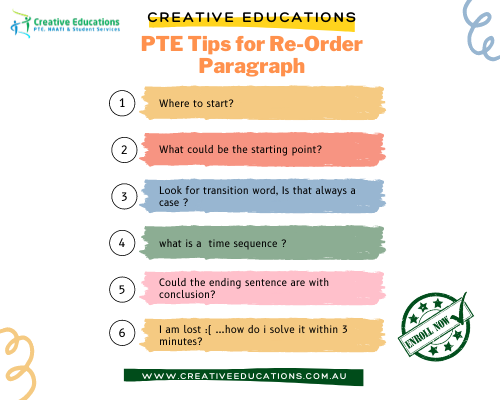
PTE Re-Order Paragraph

In the PTE Re-Order Paragraph task, you will see two text boxes. On your left, you will see text boxes in random order. And on your right, you will see empty text boxes where you will need to put those sentences in the correct order.

We have seen that majority of our students struggle with this task as it needs a deeper understanding of the English language, the context of the sentences to identify the correct order for this task. That’s why let’s break this section down and take a look at some tips to get a good score in the PTE Re-Order Paragraph task.

But before we go into the tips and strategies for this task, we just wanted to let you know that PTE assesses your Reading skill in this section. And there is no negative marking in this section.

Moving on… here’s what you need to do to breakdown this section.

Identify the Key Idea

Each text box has one key idea in it. So, begin this task by identifying the main idea in each text box. To do that, read each text box individually and keep a note of the key idea in each box.

Here’s what every paragraph has in it… An Introduction, the Body and the Conclusion.

Therefore, what we do is, we identify those parts. But how do we do that? To find out… read on…

The Introduction

An introduction is called an introduction because it introduces an idea. Not very helpful, is it? Okay… let’s try something else.

An introduction is the basis of the entire paragraph. It helps us know what the rest of the paragraph is about. Hence, in the re-order paragraph task, you need to be on a lookout for an introduction about an idea.

But you know what… you don’t always need to find the introduction first. So, let’s move on to the next item.

The Body

In the body, the main idea from the introduction is expanded upon. So, for this part, you should be on the lookout for transition words. But remember… the body is the biggest part of any text. 

A long body can have multiple paragraphs. Your task, therefore, is to identify all the key ideas presented in the body and then re-order then correctly.

Here’s how you can do that…

Look for transition words

Transition words like, “furthermore”, “moreover”, “in addition to”, “firstly” … are the guides you need to look for in the body paragraphs. These are the giveaways that will help you re-order the text boxes in this section correctly.

Now, let’s dive deeper into this.

Look for a time sequence.

By this I mean, look at any hint of time in the sentences. Doing this will help you identify which event happens earlier and which later, thus, giving you a valuable hint in re-ordering your paragraphs.

Look for links

When we say look for links, what you need to do is look for personal pronouns (he, she, they, their, those). The reason we say this is because personal pronouns refer to nouns introduced earlier in the passage.

This means, the sentences with personal pronouns always come after the sentences with the introductory noun. And this helps you in re-ordering your paragraphs correctly.

And the final part is the conclusion. This is always the closing remark in the sentence and it is almost the same as an introduction in some texts. Therefore, it is easy to get confused between introduction and conclusion. So, let’s take a look at ways to differentiate between introduction and conclusion.

The Conclusion

This part always summarises the theme of the entire passage. So, when you are reading, keep a lookout for any hints of summarisation of the text. Words like “in conclusion”, “to sum up, “in the end” are easy ways to identify the conclusion. Now, when the conclusion is not so apparent, take a look at other paragraphs and their key ideas. This can help you eliminate the sentences that are not the conclusions.

Another technique is to look for sentences that try to give you an overall or bird’s eye view of the entire passage. Doesn’t make sense? It’s okay. With enough practice, you will start understanding and identifying the sentence structures and you can re-order them.

For that, if you need expert guidance, you can always contact us to enrol in our PTE courses. Give us a call at 0422 279 722 or send us an email at: info@creativeeducations.com.au

Till next time!! Keep practicing.
Categories
PTE Tips

PTE Reading: Multiple Choice, Multiple Answer

Just like the Multiple-Choice, Single Answer task, in the PTE Reading Multiple Choice Multiple Answer task, you will see a passage on the left with up to 300 words and a set of questions with multiple options on the right side.

However, unlike the Multiple Choice Single Answer, in this section, there is negative marking. Thus you must be much more careful in selecting your response.

We have seen many of our students jump in and read the passage straightaway. But that is a big no-no. Instead, our suggestion is to read the questions and possible answers.

By doing this, you can easily identify the gist of the passage. Also, by reading the question and the possible options, you become much better equipped to look for the answer in the passage.

Many of the tips and strategies for this section will be similar to Multiple Choice Single Answer section. So, let’s take a look at a few general tips that will help you zero in on the correct choices without wasting your time.

Read the question and the options first

Read the question first and the options first. Doing this helps you identify the keywords that you need to lookout for in the passage. This way, when you read the passage, you will know exactly what to look for and thus can scan and skim the passage fast.

Skim the text

After you identify the keywords you need to lookout for, scan, and skim the text and look for instances where your keywords or their synonyms appear. When you find what you need in the passage, read around those areas because you are close to your answers.

Eliminate

To really get the correct answers, you need to look at the options again and then eliminate all the options that don’t fit in. If an option is in contrary or is unrelated to the contents of the page, then you can safely eliminate your answer and get closer to the correct answers.

Beware of negative marking

That’s the key difference between Multiple Choice Single Answer and Multiple Answer sections. In the single answer section, there is no negative marking but in this section, you will be marked negatively for your wrong answers. So, be aware of that fact. Every incorrect response will give you a -1 and every correct response will give you a +1.

Don’t waste your time

Now, just because we said you need to be careful about the negative marking in this section, it doesn’t mean that you need to waste your time trying to get all the right answers. The optimal time we recommend that you spend in this section is a maximum of 2 minutes.

If in those 2 minutes you haven’t found all the options, just select the ones you feel are correct and then move onto the next section.

This way you will save valuable time and cover up for any errors in the other sections.

In summary, here’s what you need to do to…

Read the questions, the options, and then identify the keywords.

Look for those keywords in the passage. To do that, skim and scan the entire passage for the keywords.

Then eliminate the unlikely answers. If you are in doubt, make your best guess and move on to another question. You don’t need to waste more than 2 minutes in this section.

If you want to read more you can read our blog on PTE tips.

And if you want personal feedback from the trainer, you can always contact us on 0422 279 722 or send us an email at info@creativeeducations.com.au

Categories
PTE Tips

PTE Reading- Multiple Choice Question

There are two Multiple choice questions in PTE Exam. Today we will deal with multiple-choice, single answer from the PTE Reading section.

Here you will get a passage of up to 300 words. You’ll see the passage on the left side and on the right side, you will see multiple-choice questions with several answers. In this question type, there is only ONE correct answer.

First, we’ll look at how the question type is scored, and then we’ll go into ways to find that correct answer…

Scoring Metric

In this question type, only your reading score is evaluated. This is where the PTE AI judges your ability to analyze, interpret, and evaluate a short passage. As there is no negative marking in this section, you should always attempt all the questions, even if you are unsure about your answer.

With that out of the way, let’s dive deeper into the best approaches for you to find correct answer.

Let us summarize the steps for you and we’ll discuss each approach in detail.

  1. Read the question first to identify keywords
  2. Skim the text
  3. Eliminate
  4. Don’t waste time reading the whole textgo with your guts

Now let’s begin our step-by-step approach to find the correct answer in PTE Reading Multiple Choice questions.

Read question first

Immediately upon the start of this question, you will see a wall of text on your left and a set of multiple-choice questions on your right.

Now, if you start by reading the text, you will get overwhelmed.

That’s why we suggest you always read the questions first. And then look at the answers.

The reason why we say this is because… once you look at the question and its possible answers, you will have a good idea of what the text is about. You’ll understand the context of the passage.

And doing this helps you in identifying the keywords you need to look out for, in the text. This means you’ll have a good idea of where to start and what to look for to get your answer.

Skim the text

After that, we recommend that you skim the text. Keep an eye out for the keywords and their synonyms. When you see anything related to your keywords, you’ll know that you are close to getting the correct answer.

Eliminate

One easy way you can get close to a correct answer is by matching and eliminating the options with what you find in the text.

To do this, you must understand the context of your question and the text in which your closest answer appears in.

Usually, the incorrect answers are unrelated to the context of your question and the text. So, find your keywords and read around them to hone in on the correct answer.

Don’t waste time reading the whole textGo with your guts

However, don’t waste too much time in this section. As per our calculation, you have a maximum of 2 minutes for each question here.

If you find it difficult to identify the most relevant option… just pick one. As there is no negative marking… go with your guts. You may just hit the correct option 😉

And remember… just because you see the same word in the text, it doesn’t mean that you have found the right part to look in.

Read your question carefully and make sure that the keyword or its synonym appears in the same context as the question.

The key in this section is to identify the keywords, eliminate the most obvious wrong answers until you find the correct answer.

There is only so much information we can pack into a blog post for this question type. That’s why, to get a deeper insight into how to actually do a proper break-down of this question type, our only recommendation is to keep practicing.

If you need expert guidance, then you can always contact us at 0422279722 or send us an email at info@creativeeducations.com.au

Or, you can visit us at Suite 104, Level 1, 83 York Street, Town Hall, Sydney